VibeVoice ASR vs Qwen3-ASR: Comparing Multilingual Speech-LLMs for Long Audio
Compare VibeVoice ASR and Qwen3-ASR for multilingual speech, long audio, context, accents, streaming, and Speech-LLM workflows. Learn how to test both in Scribis.
Scope and product note: VibeVoice ASR and Qwen3-ASR are integrated with Scribis. Voxtral Mini 3B and Whisper are used as comparison references. The exact capabilities depend on the checkpoint and runtime, so this article distinguishes public model positioning from independent benchmark results.
The short answer: VibeVoice explores larger Speech-LLM context, while Qwen3-ASR offers clearer multilingual ASR coverage
VibeVoice ASR and Qwen3-ASR belong to a newer class of speech-to-text systems that combine acoustic modeling with a language-model route. They are not merely interchangeable replacements for traditional CTC or transducer models. VibeVoice is commonly described through a σ-VAE, ConvNeXt, and Qwen2.5-7B speech-language-model ecosystem. Qwen3-ASR uses an AuT audio encoder with Qwen3 0.6B or 1.7B language-model variants and documents offline and streaming workflows.
For content teams, VibeVoice is interesting when long audio, multilingual context, and a larger Speech-LLM design are central. Qwen3-ASR is easier to evaluate when the requirements include 30 languages, 22 Chinese dialects or accents, streaming, and documented model-size choices. Both are integrated with Scribis, where the final comparison can include captions, timestamps, editing, translation, and export.
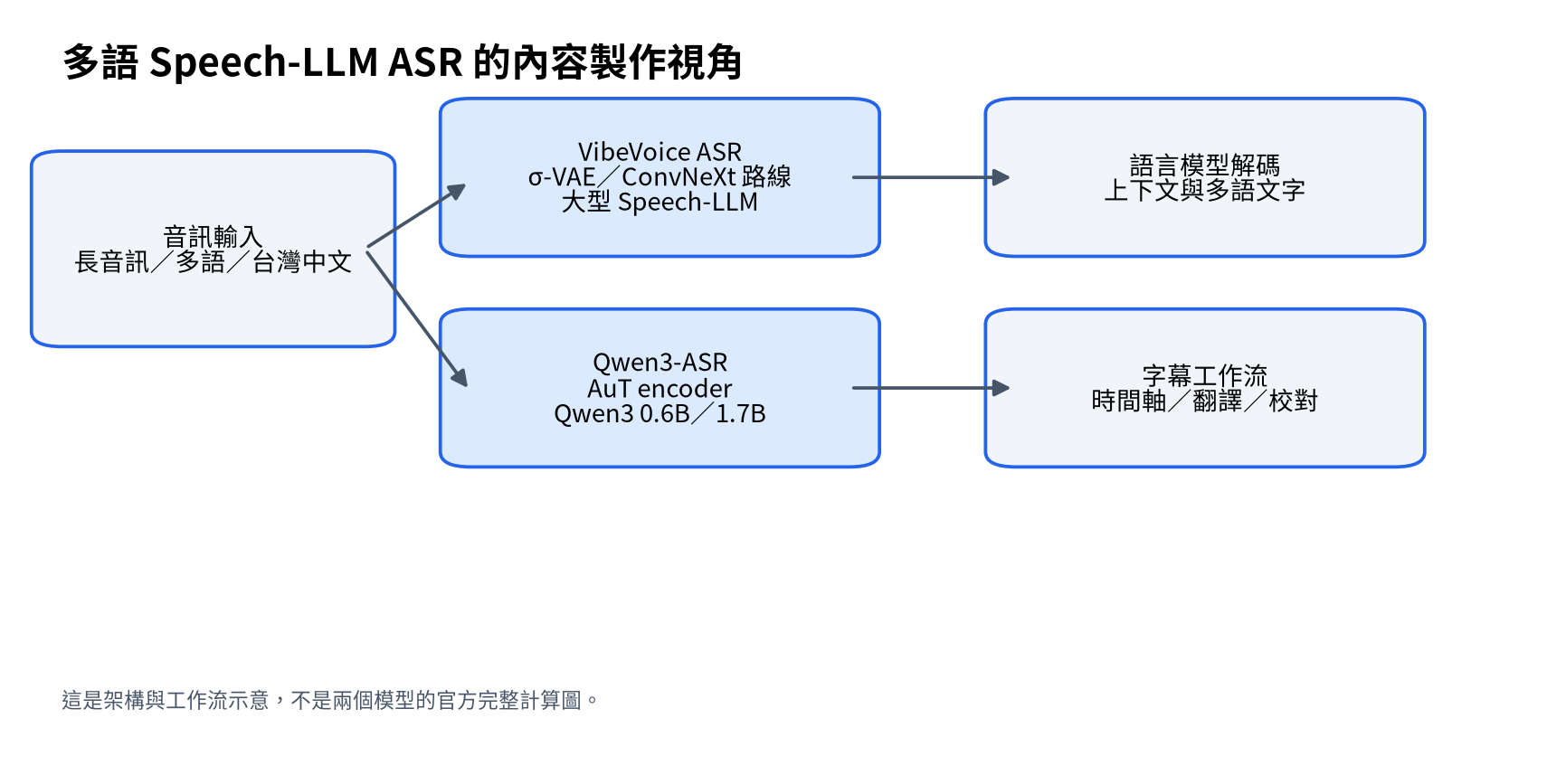
Figure: A content-workflow concept diagram, not a complete official computation graph for either model.
VibeVoice ASR: why the Speech-LLM route matters
VibeVoice ASR is positioned as a multilingual Speech-LLM system rather than a minimal speech encoder. The larger language-model route can provide more capacity for context, language switching, and difficult phrasing, but it generally comes with higher memory and serving requirements than lightweight ASR models.
This makes VibeVoice a candidate for long interviews, research archives, multilingual meetings, and content that needs more than isolated sentence recognition. It also means that deployment should be evaluated carefully. Quantization, context length, batch size, and GPU memory can change the operating profile substantially.
CrispASR lists VibeVoice-ASR and a VibeVoice-ASR-BitNet variant as ASR backends. That backend list is useful for understanding the open-source ecosystem, but CrispASR support should not be confused with the list of models integrated into Scribis.
Qwen3-ASR: multilingual coverage with two model sizes
Qwen3-ASR supports 30 languages plus 22 Chinese dialects and accents, for a total of 52 languages and accents in the published model positioning. The family includes 0.6B and 1.7B ASR models, offline and streaming paths, language identification, singing transcription, and a related ForcedAligner family for timestamps.
The 1.7B model uses an approximately 300M audio encoder in the reported architecture, while the 0.6B route uses an approximately 180M audio encoder. This provides a practical size choice: smaller deployments can prioritize throughput and concurrency, while the larger model can prioritize a wider quality margin on difficult multilingual speech.
Comparison table
| Dimension | VibeVoice ASR | Qwen3-ASR |
|---|---|---|
| Main positioning | Larger multilingual Speech-LLM route | Multilingual ASR with explicit dialect and streaming support |
| Model path | VibeVoice speech stack with Qwen2.5-7B ecosystem | AuT encoder + Qwen3 0.6B or 1.7B |
| Language focus | Depends on checkpoint and runtime | 30 languages plus 22 Chinese dialects or accents |
| Long audio | Attractive for long-context research; verify checkpoint limits | Documented single-audio workflow of about 20 minutes |
| Streaming | Depends on the selected backend | Documented in the Qwen3 workflow |
| Resource profile | Larger-model deployment; measure GPU needs | Two sizes for an efficiency/capacity trade-off |
| Scribis status | Integrated | Integrated |
Comparison with Voxtral Mini 3B and Whisper
Voxtral Mini 3B is another Speech-LLM reference. CrispASR lists mistralai/Voxtral-Mini-3B-2507 as a separate offline-oriented model from the 4B Realtime streaming model. It is a reasonable comparison when the team wants to evaluate how different language-model sizes affect transcription quality and serving cost.
Whisper Large-v3 remains an essential mature baseline. It has broad ecosystem support and is often easy to deploy through existing transcription tools. A third-party English short-form leaderboard reports Qwen3-ASR 1.7B at 5.76% average WER and 148 RTFx, Whisper Large-v3 at 7.44% WER and 146 RTFx, and Voxtral Small 24B at 6.62% WER and 54.1 RTFx.
VibeVoice is not included in that table, so no ranking should be invented. The value of the comparison is methodological: use a fixed English benchmark for baseline orientation, then use your own long-form multilingual set to evaluate the model that matters to your business.
Why long audio is a different problem
Long recordings add errors that short-form WER does not fully reveal. A system may lose context across chunks, duplicate words at boundaries, merge separate speakers, or produce inconsistent proper nouns. A large language model may help with context, but it can also increase latency and memory use.
A long-audio test should include meetings, interviews, lectures, and noisy recordings. Track chunk-boundary errors, repeated phrases, missing speech, speaker turns, timestamps, and the amount of editing required to create a publishable transcript. If the output becomes captions, measure segmentation and reading speed as well.
A practical Scribis evaluation
Build a test set with one 30-minute interview, one multilingual meeting, one lecture, and one recording containing names, acronyms, and code-switching. Run VibeVoice ASR, Qwen3-ASR 1.7B, Qwen3-ASR 0.6B, and Whisper Large-v3 where the workflow exposes them.
Review the transcripts inside Scribis. Compare the time to a usable draft, final correction time, caption segmentation, timeline alignment, translation, and export. If a larger Speech-LLM reduces only a small number of errors while requiring much more hardware, the smaller Qwen3-ASR model or Whisper may be more economical.
FAQ
Is VibeVoice ASR more accurate than Qwen3-ASR?
There is no universal answer. VibeVoice and Qwen3-ASR have different model routes, checkpoints, and public evaluation coverage. Qwen3-ASR has clearer published language and dialect details; VibeVoice should be tested on the long and multilingual audio that matters to your team.
Is VibeVoice a Scribis integration?
Yes, VibeVoice ASR is included in the product integration list used for this article. CrispASR backend support and external checkpoints remain separate concepts.
Which model is better for long recordings?
The model that preserves context, minimizes boundary errors, and reduces human editing is the better choice for your files. Test long-form behavior directly instead of extrapolating from short-form WER.
Does Qwen3-ASR provide precise word timestamps?
Qwen3 provides a related ForcedAligner family for word-, character-, and sentence-level timing. Verify that the selected Scribis workflow exposes the alignment feature you need.
Conclusion: evaluate Speech-LLMs by the work they save
VibeVoice ASR is an interesting larger-model route for multilingual and long-context speech. Qwen3-ASR offers a clearer ASR product family with two sizes, streaming, and published coverage for languages and Chinese dialects. Voxtral Mini 3B and Whisper complete the comparison set. Use Scribis to compare the time from audio input to a finished, editable content asset.
CTA: Test VibeVoice ASR, Qwen3-ASR, Voxtral, and Whisper on the same long recordings in Scribis, then evaluate transcript quality, captions, timelines, and editing time together.