Qwen3-ASR 1.7B vs Whisper: Which Speech-to-Text Model Is Better for Multilingual Transcription?
Compare Qwen3-ASR 1.7B and Whisper for multilingual speech-to-text. Review WER, RTFx, dialect coverage, long audio, timestamps, hardware trade-offs, and the Scribis workflow.
Scope and product note: Qwen3-ASR 1.7B and Whisper are integrated with Scribis. FireRedASR2-AED and Fun-ASR-Nano appear here as external comparison references, not as Scribis integrations. The practical winner depends on language, audio quality, latency, hardware, and the amount of post-editing required.
The short answer: Qwen3-ASR is broader on paper, while Whisper remains the reference baseline
Qwen3-ASR 1.7B is a multilingual automatic speech recognition model designed for offline and streaming transcription. The model family supports 30 languages plus 22 Chinese dialects and accents, and it is released under Apache-2.0. Whisper Large-v3 remains one of the most widely used open speech-recognition baselines, with a large tooling ecosystem and strong community support.
For a global content team, Qwen3-ASR is attractive when the same workflow contains multiple languages, regional accents, code-switching, or long recordings. Whisper is still valuable when you need a mature, well-documented baseline that can run across many third-party tools. Both are integrated with Scribis, so the comparison can continue beyond raw transcription into captions, timelines, translation, editing, and export.
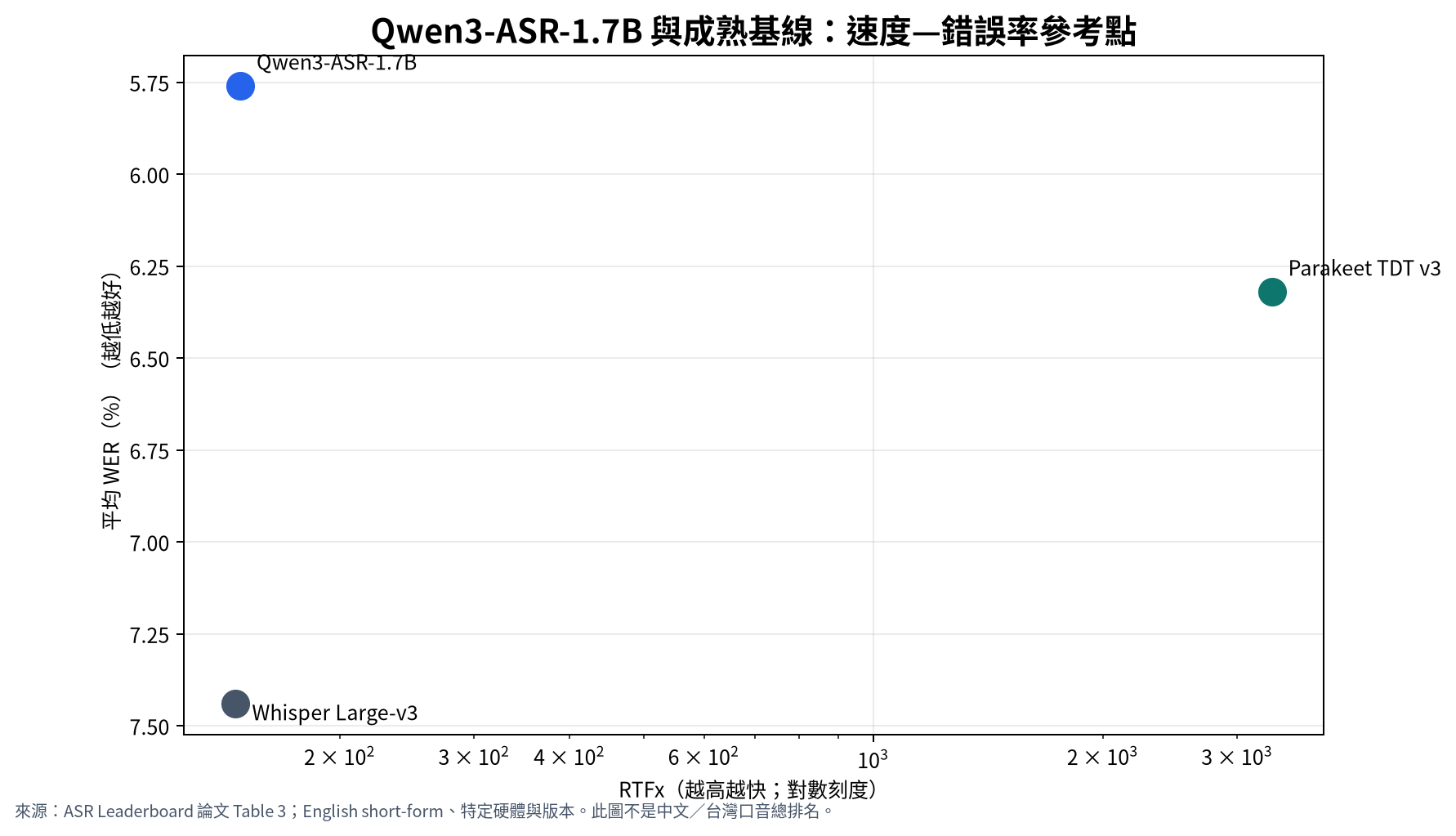
Figure: Third-party English short-form WER/RTFx snapshot. It is not a multilingual or regional-accent ranking.
What is Qwen3-ASR 1.7B?
Qwen3-ASR 1.7B combines an AuT audio encoder, a projector, and the Qwen3 1.7B language model. The technical report describes an audio encoder with approximately 300 million parameters, an 8x downsampling path, a 12.5 Hz audio-token rate, and dynamic attention windows designed for long audio.
The model card lists offline and streaming inference, language identification, audio transcription, singing transcription, and a maximum single-audio duration of roughly 20 minutes in the documented workflow. A related Qwen3-ForcedAligner model supports word-, character-, and sentence-level timestamps for up to 300 seconds and 11 languages.
These capabilities make Qwen3-ASR interesting for caption production rather than only plain text extraction. However, forced alignment is a separate model and a separate measurement problem. A transcription model should not be described as providing precise word timestamps unless the product pipeline actually includes an aligner.
Why Whisper remains important
Whisper is a strong baseline because it is familiar, portable, and supported by a broad ecosystem of wrappers, quantized checkpoints, timestamp tools, and post-processing pipelines. Whisper Large-v3 is not necessarily the fastest option, but it is often the model developers use to establish a first quality reference before testing newer architectures.
For content teams, a mature baseline also improves model selection. If Qwen3-ASR produces fewer corrections than Whisper on your interviews, lectures, or webinars, that is useful evidence. If it does not, Whisper may still be preferable because your existing subtitle tools, prompts, and post-processing already work well.
Public benchmark snapshot
The ASR Leaderboard research paper reports an English short-form comparison on a fixed A100-SXM4-80GB setup. In its reported snapshot, Qwen3-ASR 1.7B achieved an average WER of 5.76% and RTFx of 148, while Whisper Large-v3 reached 7.44% WER and RTFx of 146. Parakeet TDT 0.6B v3 reached 6.32% WER and RTFx of 3,330.
WER means word error rate: lower is better. RTFx means audio duration divided by processing time: higher is faster. These values are useful for understanding one test condition, but they do not answer every real-world question. The data is English short-form, the hardware is fixed, and the benchmark does not directly measure the quality of multilingual long-form captions.
| Dimension | Qwen3-ASR 1.7B | Whisper Large-v3 |
|---|---|---|
| Main positioning | Multilingual ASR with Chinese dialect coverage | Mature multilingual ASR baseline |
| Languages | 30 languages plus 22 Chinese dialects or accents | Broad multilingual coverage; verify the target language in your pipeline |
| Offline transcription | Supported | Supported |
| Streaming | Supported in the documented Qwen3 workflow | Depends on the serving wrapper |
| Long audio | Documented single-audio workflow of about 20 minutes | Depends on chunking and runtime |
| Forced alignment | Separate Qwen3 aligner family | Usually a separate tool such as WhisperX or a forced aligner |
| Scribis status | Integrated | Integrated |
What about FireRedASR2-AED and Fun-ASR-Nano?
FireRedASR2-AED is an external Chinese-focused comparison model with support for Mandarin, Chinese dialects and accents, English, code-switching, and singing transcription. FireRed’s official model card reports 3.05% average CER across four Mandarin benchmarks and 11.67% across 19 Chinese dialect and accent benchmarks for FireRedASR2-AED. Those are vendor-reported results on a different evaluation suite, not a replacement for the English WER table above.
Fun-ASR-Nano is another external reference from the FunASR ecosystem. It targets Chinese dialects, English, Japanese, and industry speech, and is more useful as a comparison when your recordings are multilingual or domain-specific. Neither model should be described as a Scribis integration in this article.
How to evaluate the models for global content
A useful evaluation set should contain the languages and recording conditions that matter to your business. Include at least one clean single-speaker sample, one meeting or interview with overlapping speech, one long-form recording, one noisy mobile recording, and one file containing names, numbers, product terms, and acronyms.
Record more than WER. Also measure the time to the first usable transcript, the number of subtitle segmentation fixes, proper-noun corrections, speaker-label errors, and total human editing time. A model with a slightly lower WER may still be slower to publish if its sentence boundaries or timestamps require extensive repair.
Using Qwen3-ASR and Whisper in Scribis
Scribis is useful when the result must become a finished content asset rather than a raw text file. You can import audio or video, generate a transcript, edit captions, translate or refine the text, work with timelines, and export the result. Running Qwen3-ASR and Whisper through the same content workflow makes the comparison more meaningful than copying two transcripts into separate documents.
For multilingual teams, a practical approach is to use Qwen3-ASR 1.7B for the first pass on mixed-language or accent-heavy material, then compare Whisper on a representative sample. If the difference is small, choose the model that integrates best with your hardware and editing process. If Qwen3-ASR substantially reduces correction time, its broader language and dialect positioning may justify the change.
FAQ
Is Qwen3-ASR 1.7B more accurate than Whisper Large-v3?
There is no universal answer. A third-party English short-form snapshot reports lower average WER for Qwen3-ASR 1.7B than Whisper Large-v3, but multilingual, long-form, noisy, and domain-specific results can differ. Test the languages and audio conditions that your team actually publishes.
Is Qwen3-ASR an open-source Whisper replacement?
It is an open-weight Apache-2.0 alternative with a different architecture and a strong multilingual positioning. “Replacement” should be treated as a workload-specific conclusion, not a universal claim.
Does a Qwen3-ASR transcript automatically include word timestamps?
Not necessarily. Qwen3 provides a separate ForcedAligner family for precise timestamps. Confirm that the Scribis workflow and the selected model path expose the alignment features you need.
Which model is better for subtitles?
Choose the model that produces the lowest total editing cost on your language, audio, timestamp, and speaker requirements. Scribis can help you evaluate the transcript together with caption timing and export quality.
Conclusion: compare the workflow, not only the WER
Qwen3-ASR 1.7B is a compelling choice for multilingual transcription, Chinese dialect coverage, streaming, and caption-oriented workflows. Whisper remains a reliable baseline because of its maturity and ecosystem. The best decision is to use a controlled sample, measure both recognition quality and editing time, and then choose the model that helps your team publish faster.
CTA: Test Qwen3-ASR 1.7B and Whisper on the same recordings in Scribis, then turn the better transcript into captions, a timeline, or an export-ready content asset.