Qwen3-ASR 0.6B vs 1.7B: Speed, GPU Memory, and Accuracy Compared
Compare Qwen3-ASR 0.6B and 1.7B for speed, memory, throughput, multilingual accuracy, streaming, and long-form transcription. Learn how to test both in Scribis.
Scope and product note: Both Qwen3-ASR 0.6B and Qwen3-ASR 1.7B are integrated with Scribis. This article compares the two sizes for global speech-to-text workflows. Parakeet, SenseVoice, and Whisper are external or integrated reference points depending on the model; the comparison should not be read as a universal ranking.
The short answer: use 0.6B for efficiency and 1.7B for a wider quality margin
Qwen3-ASR is available in 0.6B and 1.7B variants. Both support offline and streaming transcription, language identification, 30 languages, and 22 Chinese dialects or accents. The 0.6B version is designed as an accuracy-efficiency trade-off, while the 1.7B version allocates more language-model capacity to complex multilingual audio.
For a content operation processing thousands of short files, the 0.6B checkpoint may lower memory pressure and increase concurrency. For interviews, noisy recordings, code-switching, long-form speech, or proper-noun-heavy content, the 1.7B checkpoint may reduce manual correction. Both are integrated with Scribis, allowing a team to compare the time saved by smaller inference against the editing time saved by the larger model.
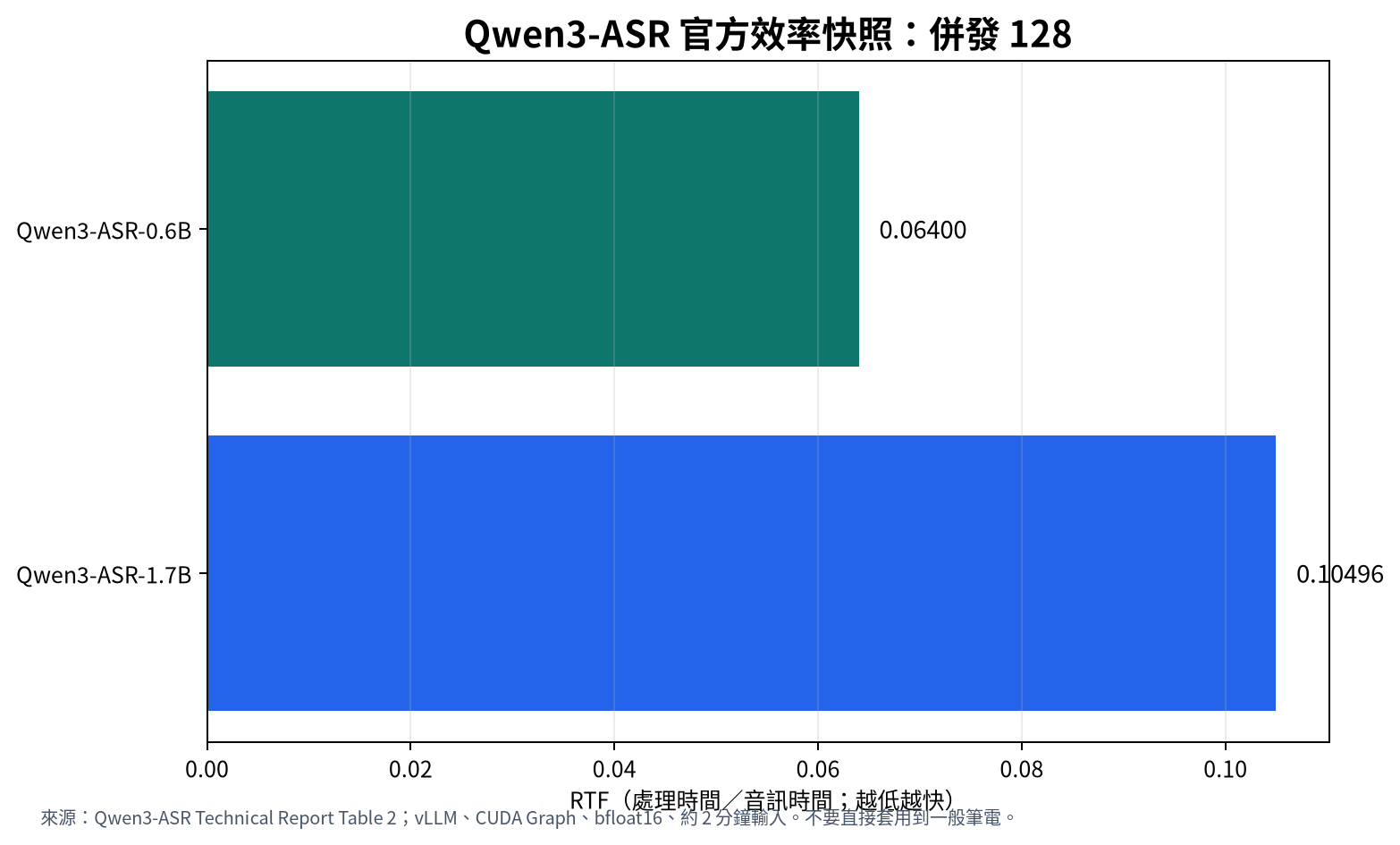
Figure: Official Qwen3 technical-report RTF snapshot at concurrency 128. The result uses a specific vLLM, CUDA Graph, bfloat16, and input-length setup.
What changes when the model gets larger?
The language model is not the only difference. The Qwen3 technical report describes an approximately 180M audio encoder for the 0.6B route and an approximately 300M audio encoder for the 1.7B route, each combined with a Qwen3 language model and projector. The larger model usually demands more memory and compute, but that cost can be worthwhile when recognition errors create expensive editorial work.
Model size also affects serving strategy. A smaller model may fit more comfortably into a shared GPU, run with more concurrent requests, or be easier to quantize. A larger model may provide more capacity for multilingual context, accents, and difficult utterances, but its p95 latency can increase under high concurrency.
Official efficiency snapshot
In the technical report’s online asynchronous experiment, Qwen3-ASR 0.6B at concurrency 128 is reported at RTF 0.06400 and throughput 2,000, while Qwen3-ASR 1.7B is reported at RTF 0.10496 and throughput 1,219.51. The average TTFT at concurrency 1 is 92ms for 0.6B and 102ms for 1.7B.
RTF means processing time divided by audio duration, so lower is faster. Throughput in this table is a serving metric under the authors’ setup, not a promise for a laptop or a hosted Scribis session. At concurrency 128, reported p95 TTFT rises to several seconds, which is a reminder that average single-request latency and high-concurrency user experience are different measurements.
| Dimension | Qwen3-ASR 0.6B | Qwen3-ASR 1.7B |
|---|---|---|
| Primary trade-off | Lower resource use and higher concurrency | More model capacity and potential quality margin |
| Audio encoder | Approximately 180M in the reported architecture | Approximately 300M in the reported architecture |
| Languages | 30 languages plus 22 Chinese dialects or accents | 30 languages plus 22 Chinese dialects or accents |
| Streaming | Supported | Supported |
| Offline transcription | Supported | Supported |
| Best first test | High-volume drafts and constrained hardware | Noisy, multilingual, accent-heavy, or proper-noun-heavy audio |
| Scribis status | Integrated | Integrated |
Comparison with Parakeet and SenseVoice
Parakeet TDT v3 is a useful speed reference. A third-party ASR Leaderboard paper reports Parakeet TDT 0.6B v3 at 6.32% average WER and 3,330 RTFx on an English short-form A100 setup; the same table reports Qwen3-ASR 1.7B at 5.76% WER and 148 RTFx. This suggests that the Qwen3 size comparison should not be reduced to “bigger always means faster” or “smaller always means better.” Decoder design, batching, and runtime matter.
SenseVoice Small is another efficiency-oriented model with ASR, language identification, speech emotion recognition, and audio event detection. It is valuable when the workflow needs more than transcription, while Qwen3-ASR is more directly positioned around multilingual and dialect coverage.
Whisper Large-v3 remains a useful baseline because teams often already have it in their tools. If the 0.6B version produces acceptable text but adds more correction work, the 1.7B version may be the better operational choice even when it has a higher RTF.
How much GPU memory do you need?
Parameter count alone does not give a complete memory requirement. Runtime precision, KV cache, audio length, batch size, concurrency, tokenizer buffers, and framework overhead all matter. Quantization may reduce memory usage, but it can change speed and accuracy. The correct hardware guidance is therefore a test plan, not a single number.
For a local deployment, measure peak allocated memory while processing a representative long-form file, then repeat with concurrent requests. For a desktop content workflow, also measure memory while the video editor, browser, and export pipeline are running. In Scribis, users should follow the hardware guidance for their product version rather than treating a model card’s server benchmark as a local guarantee.
A practical A/B test in Scribis
Create a test set with a clean lecture, a noisy meeting, a multilingual interview, and a recording containing product names and numbers. Run both Qwen3-ASR sizes on the same files. Record processing time, first usable transcript time, final correction count, proper-noun corrections, caption segmentation fixes, and total human editing time.
If the 0.6B version is only marginally worse but much faster, it may be the right default for draft generation. If the 1.7B version saves enough editorial time to offset inference cost, use it for final transcripts. A hybrid workflow can use 0.6B for triage and 1.7B for priority files.
FAQ
Is Qwen3-ASR 0.6B accurate enough for subtitles?
It can be a strong draft model, but subtitle suitability depends on language, audio quality, proper nouns, segmentation, and timestamps. Test the final caption workflow rather than judging only the transcript text.
Is Qwen3-ASR 1.7B twice as accurate as 0.6B?
No general rule says that a larger parameter count produces a fixed accuracy improvement. The benefit varies by language, noise, accents, and domain.
Which Qwen3-ASR model is better for high concurrency?
The official report shows a higher reported throughput for 0.6B under one concurrency-128 serving setup. High-concurrency p95 latency and quality still need to be measured in your own deployment.
Can both models handle streaming?
Yes, the Qwen3-ASR family documents offline and streaming workflows. Exact latency depends on the serving backend, chunk configuration, and product implementation.
Conclusion: choose the smallest model that meets your editing target
Qwen3-ASR 0.6B is a sensible first choice for high-volume drafts, lower resource use, and constrained deployments. Qwen3-ASR 1.7B is a stronger candidate when multilingual context, difficult audio, accents, and correction cost matter more than raw throughput. Scribis makes it practical to compare both against the same recordings and make the decision using publishing time rather than parameter count alone.
CTA: Run the same recordings through Qwen3-ASR 0.6B and 1.7B in Scribis, then compare not only speed but also caption corrections and time to publish.