Parakeet TDT v3 vs Nemotron 3.5: Batch Throughput or Real-Time Streaming?
Compare Parakeet TDT v3 and Nemotron 3.5 for batch ASR, real-time streaming, RTFx, chunk latency, subtitles, and hardware. See how to evaluate both in Scribis.
Scope and product note: Parakeet TDT v3 and Nemotron ASR are integrated with Scribis. Voxtral 4B Realtime is also integrated and appears as a real-time comparison point. The article separates batch throughput from streaming latency because the two workloads reward different architectures.
The short answer: Parakeet is built for throughput, while Nemotron is built for streaming efficiency
Parakeet TDT v3 and Nemotron 3.5 ASR both prioritize efficient inference, but they optimize different user experiences. Parakeet TDT v3 is a high-throughput FastConformer and Token-and-Duration Transducer model. Nemotron 3.5 is a 600M-class cache-aware FastConformer-RNNT model designed to reuse encoder state as new audio chunks arrive.
Choose Parakeet first when you need to process a large archive of videos, lectures, or recordings. Choose Nemotron first when the application receives a continuous stream and users need partial transcripts with predictable delay. Both models are integrated with Scribis, so the comparison can be made inside a real caption and editing workflow.
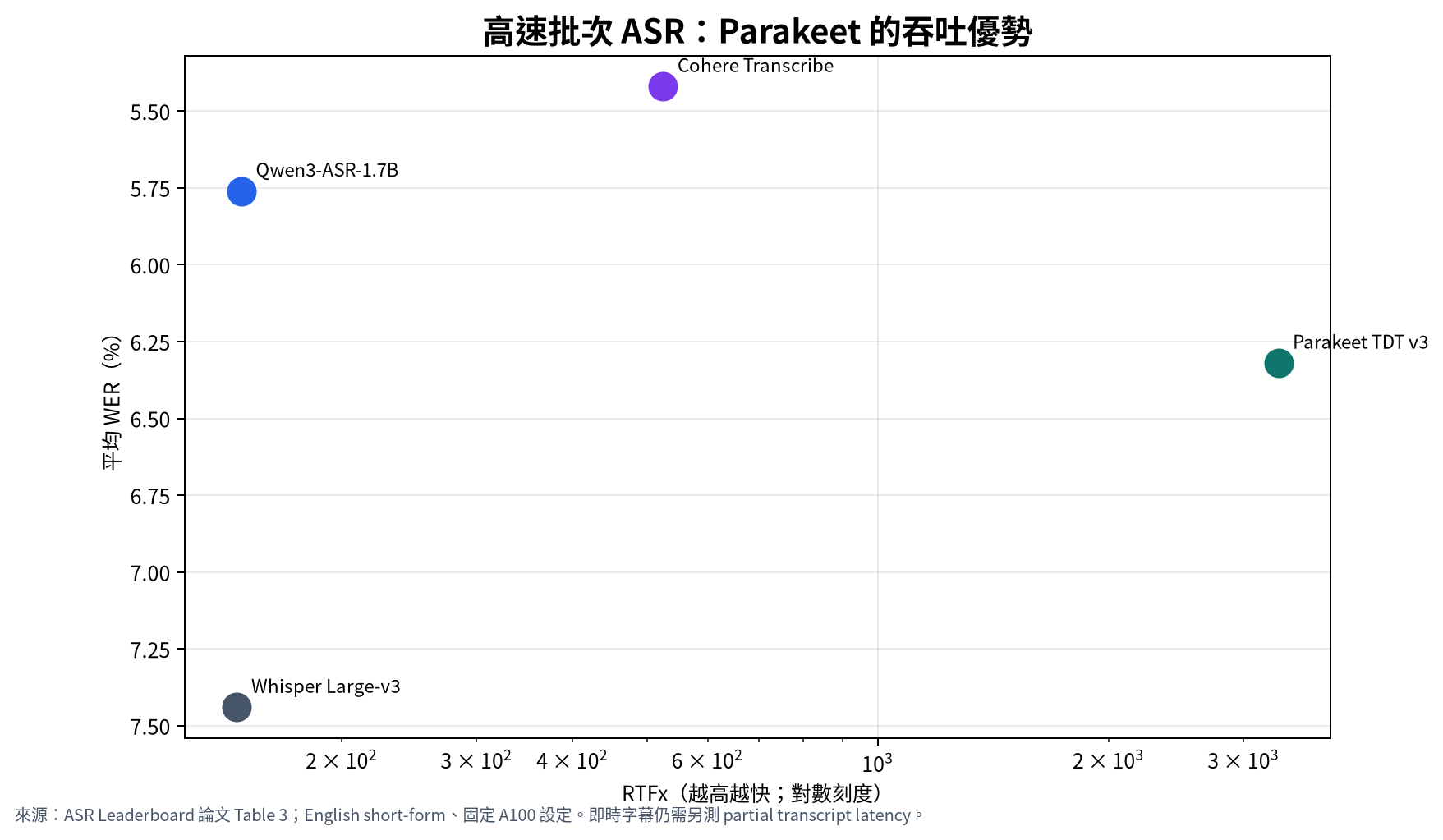
Figure: English short-form WER/RTFx snapshot on a fixed A100 setup. High RTFx does not automatically mean better real-time captions.
What makes Parakeet TDT v3 fast?
Parakeet is part of the NVIDIA NeMo ecosystem and uses the FastConformer family. TDT, or Token-and-Duration Transducer, predicts both token content and duration information, which can make decoding efficient for streaming or batch workloads.
In a third-party ASR Leaderboard paper, Parakeet TDT 0.6B v3 is reported at 6.32% average WER and 3,330 RTFx on an English short-form A100-SXM4-80GB setup. Qwen3-ASR 1.7B is reported at 5.76% WER and 148 RTFx, while Whisper Large-v3 is reported at 7.44% WER and 146 RTFx.
RTFx is audio duration divided by processing time, so higher is faster. The Parakeet result is a useful throughput reference, not a universal claim across languages, batch sizes, or laptops. In production, memory bandwidth, batching, CUDA versions, and input distribution can change the ranking.
Why Nemotron 3.5 is a streaming model
Nemotron 3.5 ASR uses a cache-aware FastConformer-RNNT design. In a sliding-window system that recomputes overlapping audio, the same context can be processed repeatedly. Cache-aware inference retains useful encoder state and processes only the new portion of the stream.
The official model card describes roughly 39–40 language-locales, depending on whether the count is based on locales or language tags. It documents configurable chunk settings such as 80, 160, 320, 560, and 1120 milliseconds, along with punctuation and capitalization output. A product article should not convert different locale-counting conventions into a single exact language claim.
| Dimension | Parakeet TDT v3 | Nemotron 3.5 ASR |
|---|---|---|
| Main positioning | High-throughput batch ASR | Low-latency streaming ASR |
| Core architecture | FastConformer + TDT | Cache-aware FastConformer-RNNT |
| Key strength | RTFx and batch throughput | Cache reuse and chunk-level latency |
| Typical content | Large video or lecture archives | Live meetings, captions, and voice agents |
| Language count | Depends on model and runtime | Approximately 39–40 language-locales, per official counting |
| Scribis status | Integrated | Integrated |
How Voxtral 4B Realtime fits in
Voxtral Mini 4B Realtime is an open-weight Mistral streaming transcription model with a custom causal audio encoder and a 4B language model. Its model card lists 13 languages, Apache-2.0 licensing, native streaming, and configurable delay. The documented range includes approximately 240ms to 2.4 seconds, with a 480ms setting suggested as a quality and latency compromise.
Nemotron is smaller and more explicitly optimized around cache-aware streaming. Voxtral is larger but brings a speech-language-model route and an open streaming architecture. If the application needs low delay with richer language-model context, Voxtral deserves a direct test; if concurrency and hardware efficiency dominate, Nemotron may be easier to operate.
How to read a speed benchmark
A high RTFx number is not the same as a short time to first caption. Batch throughput measures how quickly a system processes a completed file. Streaming latency measures when partial text appears, how often it changes, and when the transcript becomes stable.
For a fair test, record at least five metrics: time to first partial transcript, time to stable segment, full-file completion time, final WER or CER, and human correction minutes. Add memory usage and cost per hour if the system runs continuously. A model that wins RTFx but creates unstable segments may still be slower to publish.
A practical Scribis test plan
Use a 30-second clip, a five-minute meeting, and a 30-minute lecture. Include one clean single-speaker file, one recording with overlap, and one file with names and technical terms. Run Parakeet TDT v3, Nemotron 3.5, and Voxtral 4B Realtime when the product workflow exposes them for your test.
Review the transcript in the caption timeline. Count segmentation repairs, timing changes, punctuation errors, and revisions to partial text. Then export the result and confirm that subtitle timing remains usable outside the editor. This makes a benchmark relevant to the final content workflow rather than only to model researchers.
FAQ
Is Parakeet TDT v3 better than Nemotron 3.5?
They target different workloads. Parakeet is a strong batch-throughput candidate, while Nemotron is designed for streaming efficiency. The better model is the one that matches your latency, throughput, language, and editing requirements.
Is higher RTFx always better?
No. Higher RTFx means faster processing under the reported setup. It does not directly measure accuracy, time to first partial transcript, timestamp stability, or human editing time.
Does Nemotron support multiple languages?
Yes, the official model card describes approximately 39–40 language-locales, with counting differences between locale and language tags. Verify the target language and version before deployment.
When should I test Voxtral 4B Realtime?
Test it when native streaming, adjustable delay, and a larger speech-language-model route are important. It has a higher model size than Nemotron, so measure memory and concurrency as well as transcript quality.
Conclusion: separate batch speed from interactive latency
Parakeet TDT v3 is a strong candidate for high-throughput archive processing. Nemotron 3.5 is a focused candidate for cache-aware real-time streaming. Voxtral 4B Realtime offers another integrated route for native streaming and adjustable delay. Use Scribis to compare the models on the same files, then choose based on time to publish rather than a single speed number.
CTA: Compare Parakeet TDT v3, Nemotron 3.5, and Voxtral Realtime in Scribis, then evaluate the full transcript, caption timeline, and export workflow.