Paraformer-zh vs Fun-ASR-Nano: Which Model Is Better for Multilingual and Domain Speech?
Compare Paraformer-zh and Fun-ASR-Nano for Chinese, multilingual, dialect, domain, low-latency, and subtitle workloads. Learn how to test an integrated Paraformer workflow in Scribis.
Scope and product note: Paraformer-zh is integrated with Scribis. Fun-ASR-Nano is included as an external comparison reference and is not described as a Scribis integration. This article compares focused Chinese ASR with broader multilingual and domain-speech coverage.
The short answer: Paraformer is focused and efficient; Fun-ASR-Nano targets broader speech coverage
Paraformer-zh and Fun-ASR-Nano are both associated with the FunASR ecosystem, but they occupy different points on the deployment spectrum. Paraformer-zh is an approximately 220M non-autoregressive Chinese/English ASR model built for efficient transcription. Fun-ASR-Nano-2512 is an approximately 800M end-to-end model positioned around Chinese dialects, English, Japanese, and industry speech.
Choose Paraformer-zh when you need fast Chinese captions, customer-support transcripts, or a lightweight deployment path. Choose Fun-ASR-Nano as an external candidate when the recordings contain dialects, Japanese, English, or specialized domain speech. Scribis integrates Paraformer-zh; Fun-ASR-Nano should be tested through the relevant external tool or deployment path rather than assumed to be available inside Scribis.
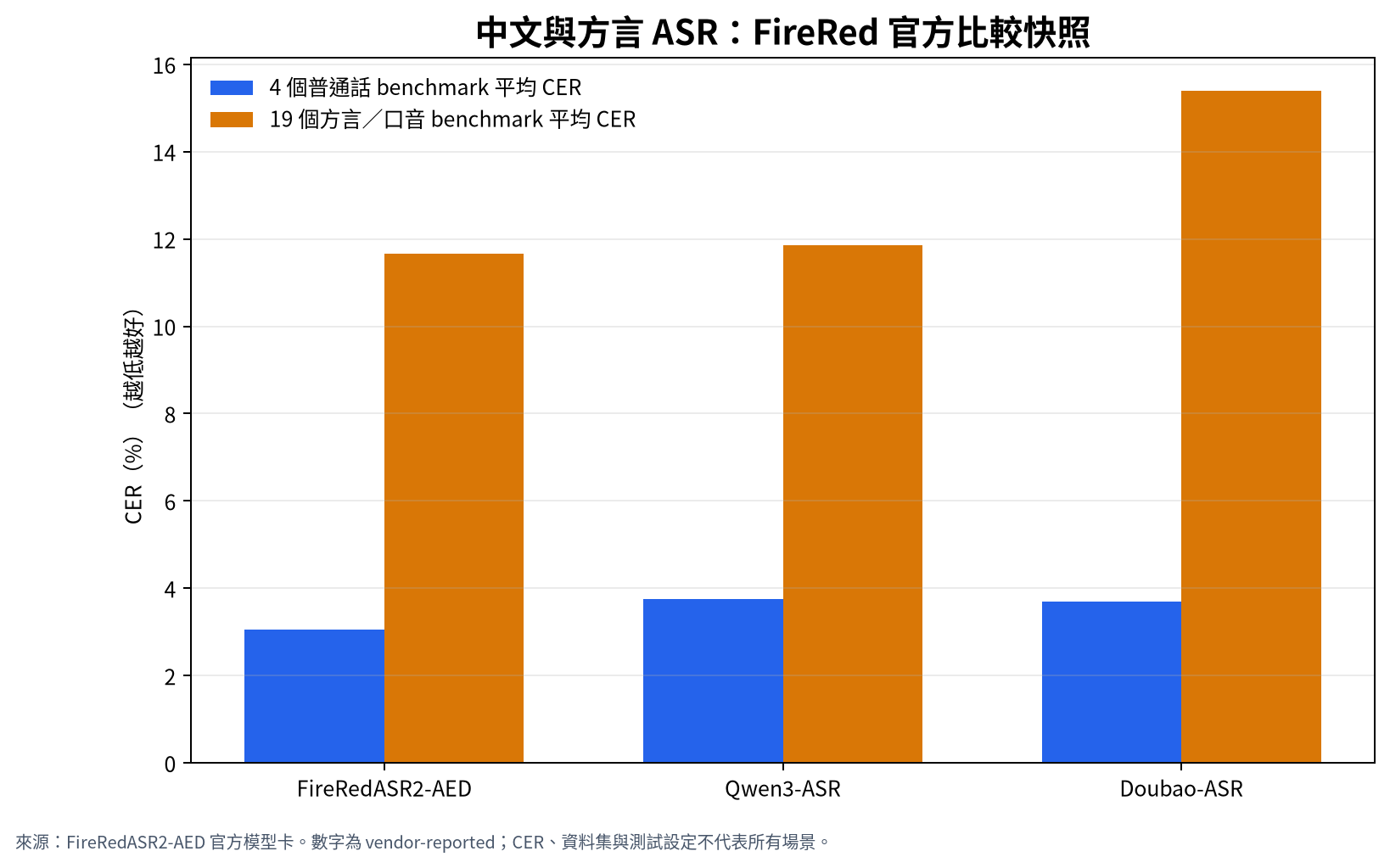
Figure: FireRed’s vendor-reported comparison snapshot. It illustrates why Mandarin and dialect accuracy should be evaluated separately; it is not a Paraformer or Fun-ASR benchmark.
What is Paraformer-zh?
Paraformer uses a SANM encoder, a CIF predictor, and a non-autoregressive decoder. The architecture is designed to produce text efficiently without relying on a fully autoregressive token-by-token decoder.
That design is useful for high-volume transcription. A customer-support team may prefer predictable latency and a smaller deployment footprint over a broader speech-language-model capability. Paraformer-zh can also be combined with VAD, punctuation, speaker processing, and other pipeline modules, but those additional capabilities should be described as pipeline components rather than as native features of every checkpoint.
What is Fun-ASR-Nano?
Fun-ASR-Nano-2512 is a newer end-to-end ASR model in the FunAudioLLM family. Its model positioning includes Chinese dialects, English, Japanese, and industry speech, while the related Fun-ASR-MLT-Nano variant targets a wider multilingual set.
The larger model may help on more varied language and domain content, but it also introduces a higher resource requirement. It should be evaluated not only on clean speech but also on product names, mixed-language utterances, numbers, call-center terms, and natural conversational speech.
| Dimension | Paraformer-zh | Fun-ASR-Nano-2512 |
|---|---|---|
| Main positioning | Focused Chinese/English ASR | Multilingual, dialect, and domain ASR |
| Approximate size | 220M | 800M |
| Decoder route | Non-autoregressive | End-to-end model; verify runtime and checkpoint details |
| Best first test | Fast captions and high-volume Chinese transcription | Dialects, English/Japanese, and industry speech |
| Resource profile | Lower footprint candidate | Higher capacity and higher resource demand |
| Scribis status | Integrated | External comparison reference |
How FireRedASR2-AED helps explain the benchmark problem
FireRedASR2-AED is another external comparison point for Chinese and dialect-heavy speech. Its official model card reports FireRedASR2-AED at 3.05% average CER across four Mandarin benchmarks and 11.67% across 19 Chinese dialect and accent benchmarks. The same comparison reports Qwen3-ASR at 3.76% and 11.85%, and Doubao-ASR at 3.69% and 15.39%.
These numbers are valuable because they separate standard Mandarin from dialect and accent conditions. They are vendor-reported, use a particular benchmark suite, and do not provide a direct ranking of Paraformer-zh versus Fun-ASR-Nano. A serious evaluation should keep language, data set, normalization, and metric consistent.
CER, WER, and domain accuracy
Character error rate is often more intuitive for Chinese transcription, while word error rate is common for English and other languages with whitespace-delimited words. Neither metric captures every domain failure. A company name, a drug name, a product code, or a number can be operationally important even if it represents only a small part of the transcript.
Create a domain test set with clean speech, noise, code-switching, technical terms, accents, and long-form recordings. Measure CER or WER, but also track named-entity corrections, number errors, sentence segmentation, timestamps, and human review time.
A practical Scribis workflow
Use Scribis to transcribe the same Chinese and multilingual files with Paraformer-zh, then compare an external Fun-ASR-Nano run on a matched sample if your team needs its broader coverage. Review the result as captions rather than plain text. Correct punctuation, line breaks, speaker changes, timestamps, and terminology before export.
Paraformer-zh may be the better default when the project is primarily Chinese and speed matters. Fun-ASR-Nano may be worth the extra deployment complexity if it reduces errors on dialects or multilingual domain content. The final decision should consider the complete editing workflow and integration cost.
FAQ
Is Fun-ASR-Nano integrated with Scribis?
Not in the integration matrix used for this article. It is an external comparison reference. Paraformer-zh is the integrated model discussed in the Scribis workflow.
Is Paraformer-zh only for Chinese?
Its primary positioning is Chinese and English ASR. Verify the language and quality requirements for any additional language rather than inferring them from the broader FunASR ecosystem.
Which model is better for dialect speech?
Fun-ASR-Nano is a reasonable external candidate because its positioning explicitly includes Chinese dialects. Paraformer-zh should still be tested because a lighter model may be sufficient for your specific speakers and domain.
Should I compare CER or WER?
Use the metric that matches the language and evaluation protocol, then report the data set and normalization rules. Do not combine CER from one language with WER from another into a single ranking.
Conclusion: choose focused efficiency or broader coverage
Paraformer-zh is a strong integrated option for efficient Chinese and English transcription, captions, and customer-support workflows. Fun-ASR-Nano is an external model worth evaluating when dialects, Japanese, English, or industry speech are central. FireRedASR2-AED and Qwen3-ASR add useful Chinese and dialect comparison points, but their published numbers must remain tied to their original benchmark conditions.
CTA: Start with Paraformer-zh in Scribis, compare the transcript and caption editing time against your external candidates, and choose the workflow that delivers publishable results fastest.