Nemotron 3.5 ASR vs Voxtral 4B Realtime: Which Streaming Model Should You Choose?
Compare Nemotron 3.5 ASR and Voxtral Mini 4B Realtime for streaming transcription, chunk delay, real-time captions, language coverage, hardware, and Scribis workflows.
Scope and product note: Nemotron 3.5 ASR and Voxtral Mini 4B Realtime are integrated with Scribis. This article focuses on interactive speech-to-text, live captions, meetings, and voice agents. A delay setting is not the same thing as a quality score.
The short answer: Nemotron prioritizes efficient streaming; Voxtral brings a larger speech-language-model route
Nemotron 3.5 ASR is a 600M-class multilingual streaming model built around cache-aware FastConformer-RNNT. Voxtral Mini 4B Realtime is a 4B open-weight Mistral transcription model with a custom causal audio encoder and native streaming architecture.
Nemotron is attractive when the application receives continuous audio and needs efficient state reuse. Voxtral is attractive when adjustable delay, native streaming, and a larger language-model component matter. Both are integrated with Scribis, which lets a team compare not only transcript text but also caption stability, timeline behavior, and export quality.
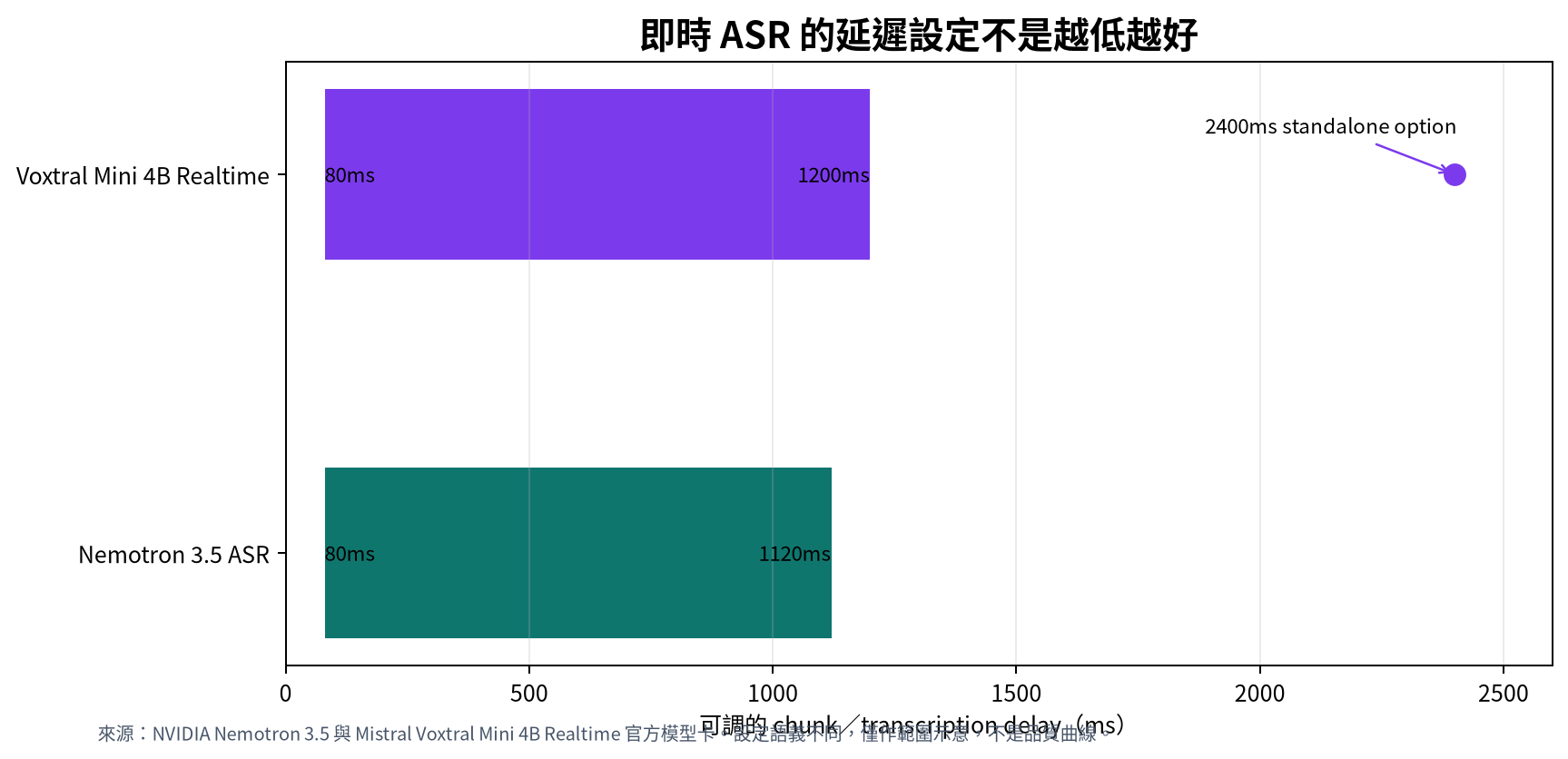
Figure: Documented configuration ranges, not a quality curve. Different runtimes use different meanings for chunk and transcription delay.
How Nemotron 3.5 works
Nemotron’s cache-aware streaming design keeps useful encoder state from earlier audio chunks. A naive sliding-window implementation may repeatedly recompute overlapping context; cache reuse reduces that work and is intended to keep latency predictable as audio continues.
The official model card describes approximately 39–40 language-locales, depending on whether language tags or locales are counted. It documents chunk settings such as 80, 160, 320, 560, and 1120 milliseconds, plus punctuation and capitalization output.
The practical advantage is a clear control over the latency–context trade-off. A smaller chunk can show partial text sooner, but may provide less context to the recognizer. A larger chunk may stabilize text but make the interface feel less immediate.
How Voxtral Mini 4B Realtime works
Voxtral Mini 4B Realtime combines a causal audio encoder with a 4B language model. Its official model card lists 13 languages, Apache-2.0 licensing, native streaming, and a configurable transcription delay. The documented choices range from approximately 240ms to 2.4 seconds, with 480ms suggested as a practical quality and latency compromise.
The model card also describes low-delay operation, on-device deployment scenarios, live subtitling, private meeting transcription, and real-time assistants. The 4B size is larger than Nemotron, so a production test should include memory, concurrency, and thermal behavior rather than only the first partial result.
| Dimension | Nemotron 3.5 ASR | Voxtral Mini 4B Realtime |
|---|---|---|
| Main positioning | Efficient multilingual streaming ASR | Open-weight speech-language-model streaming ASR |
| Approximate size | 600M | 4B |
| Core route | Cache-aware FastConformer-RNNT | Causal audio encoder + language model |
| Language coverage | Approximately 39–40 language-locales, per official counting | 13 languages |
| Delay control | Multiple chunk settings up to 1120ms | Approximately 240ms–2.4s, with 480ms as a documented compromise |
| Best first test | Continuous streams and resource-sensitive services | Live captions with adjustable delay and larger model capacity |
| Scribis status | Integrated | Integrated |
Why “real time” is more than first-token latency
A live caption interface has several meaningful timestamps: audio capture, first partial text, a stable segment, and the final corrected segment. A model may display words quickly but revise them often. Another model may wait slightly longer and produce more stable captions.
For a useful comparison, measure time to first partial transcript, time to stable segment, final transcript completion, text error rate, number of partial revisions, and human caption corrections. Also measure memory and cost if the system will run continuously.
This is especially important for meetings. Overlapping speakers, background noise, names, and interruptions can make a low nominal delay less useful if the transcript is unstable or incorrectly segmented.
Comparison with Parakeet and Qwen3-ASR
Parakeet TDT v3 is a strong high-throughput batch reference. A third-party English short-form leaderboard reports 6.32% average WER and 3,330 RTFx for Parakeet TDT v3 on a fixed A100 setup. It can be an excellent archive-processing model, but batch RTFx should not be treated as live partial-transcript latency.
Qwen3-ASR 0.6B and 1.7B support offline and streaming workflows, 30 languages, and 22 Chinese dialects or accents. For global teams working with multilingual speech, Qwen3 provides another integrated point of comparison. The choice depends on target languages, delay, hardware, and how much post-editing the final captions require.
A practical Scribis test plan
Prepare three files: a 30-second live-style clip, a five-minute meeting, and a 30-minute lecture. Include one clean speaker, one two-person conversation, and one recording with names, numbers, and background noise. Test Nemotron and Voxtral at at least two delay settings when available.
Review the result inside the caption timeline. Count unstable words, segmentation repairs, punctuation problems, speaker-turn errors, and time-to-export. If the content is primarily archival, also compare Parakeet TDT v3. If the content is multilingual or accent-heavy, add Qwen3-ASR to the test.
FAQ
Is Nemotron 3.5 faster than Voxtral 4B Realtime?
Nemotron is smaller and specifically designed around cache-aware streaming, while Voxtral is a larger 4B model with native streaming. The actual answer depends on hardware, chunk settings, runtime, and concurrency.
What does a 480ms Voxtral delay mean?
It is a configurable transcription-delay setting that balances responsiveness and context in the documented workflow. It is not a universal quality guarantee.
Does Nemotron support many languages?
The official model card describes approximately 39–40 language-locales, with differences depending on counting conventions. Always verify the target language and model version.
Should I use Parakeet for live captions?
Parakeet is a valuable high-throughput reference, but its batch benchmark does not directly measure live caption behavior. Test partial output and segment stability for real-time use.
Conclusion: choose by interaction model, not only model size
Nemotron 3.5 ASR is a strong candidate for efficient continuous streaming and cache reuse. Voxtral Mini 4B Realtime is a strong candidate for native streaming, adjustable delay, and a larger speech-language-model path. Use Scribis to evaluate both on realistic meetings and caption files, then choose the model that produces stable, publishable results.
CTA: Compare Nemotron 3.5 and Voxtral 4B Realtime in Scribis, then judge the complete live-caption workflow: partial output, stable segments, timeline editing, and export.