Blog
Stay updated with the latest in AI voice technology.
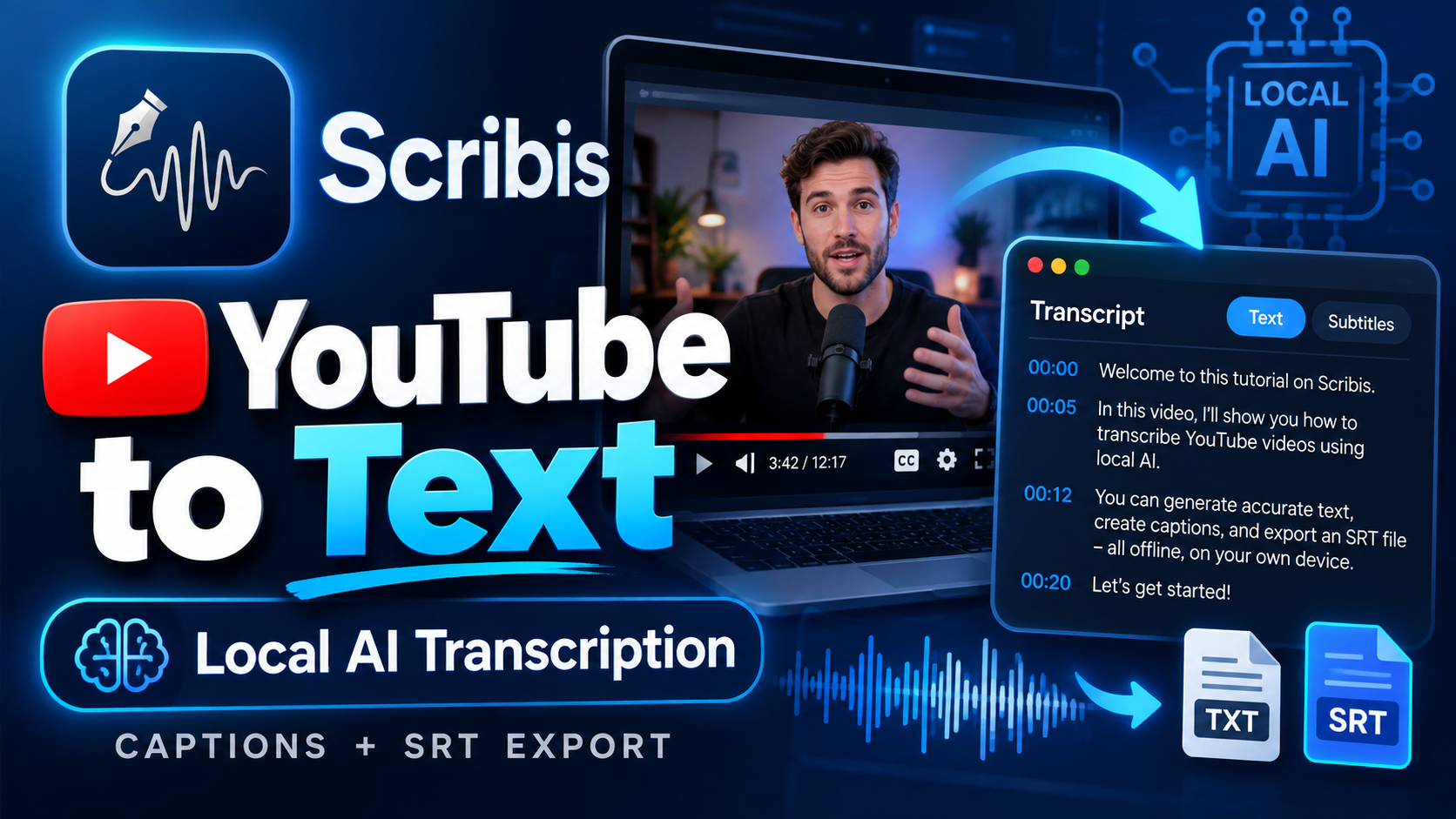 Latest postHow to Convert YouTube Videos to Text with Scribis: Local AI Transcription, Subtitle Extraction, and SRT ExportConvert YouTube videos to text directly from URLs. Learn how to configure yt-dlp, extract existing subtitles or use local ASR models, and export SRT files in Scribis.Start reading
Publishing timeline
47 posts from Jun 10, 2026 to Oct 5, 2026. Select a day to filter.
Showing 47 of 47 posts
- How to Convert YouTube Videos to Text with Scribis: Local AI Transcription, Subtitle Extraction, and SRT ExportConvert YouTube videos to text directly from URLs. Learn how to configure yt-dlp, extract existing subtitles or use local ASR models, and export SRT files in Scribis.4 min
- Real-time Speaker Diarization with Nemotron-3 in ScribisLearn how to use NVIDIA Nemotron-3 Diarization in Scribis to identify speakers in real time during live recording and jump to speaker segments on the timeline.4 min
- Still Downloading YouTube Videos Before AI Analysis? Start Directly from URLs with ScribisStill using yt-dlp to download YouTube videos, running Whisper, and extracting transcripts before feeding them to AI? Scribis works directly from YouTube URLs, integrating subtitles, AI Chat, Vision, Mind Maps, Translation, and TTS.9 min
- Custom Voice Design & AI Video Dubbing with Qwen3-TTS in ScribisLearn how to create custom voices, clone reference audio, translate subtitles, and generate AI video dubbing using Qwen3-TTS on Mac with Scribis.4 min
- ASR Keeps Getting Names and Proper Nouns Wrong? Make Corrections RepeatableASR often mishears names, product terms, and mixed-language phrases. Use a vocabulary list, short sample tests, and precise dictionary rules to reduce repeated edits and avoid overcorrection.3 min
- Have a Transcript but Still Spending Too Long Reviewing It? Fix What Changes Meaning FirstYou do not need to treat every transcript error as equally risky. Start with names, numbers, negations, speakers, and timestamps, then plan reviews around how the transcript will be used.3 min
- Scribis Batch Transcription Guide: Add Files, Manage the Queue, and Sync FoldersAdd multiple audio or video files in Scribis, apply shared model and language settings, and follow queue progress and failed items.3 min
- Scribis Dictionary and Pronunciation Guide: Correct Recurring TermsCreate text replacement rules with the Scribis standard dictionary, and learn how to enter IPA, Zhuyin, and Pinyin in the pronunciation dictionary.2 min
- Scribis Live Transcription: Microphone, System Audio, and Live TranslationSet up the Scribis recording page, check the audio input, language, and recognition model, then follow live text and translation while recording.3 min
- Scribis Single-File Transcription Tutorial: Language, Local Models, and PromptsImport audio or video, choose a language and local ASR model, add terminology prompts, then review and organize the transcript.2 min
- Scribis Subtitle Review and Export: From Transcript Edits to SRTUse the Scribis Translation editor to replay audio, correct subtitle text and timing, review speakers, and export subtitles or a video with burned-in captions.3 min
- Too Many Recordings and Messy Transcripts? Build a Traceable WorkflowWhen processing multiple meetings or interviews, organize filenames, group similar settings, review each transcript, and keep every result linked to its source.3 min
- AssemblyAI Speech-to-Text: From English Transcripts to Content UnderstandingA basic speech-to-text API turns a recording into words. AssemblyAI is designed to go further, offering transcript features and Speech Understanding capabilities.5 min
- Azure AI Speech: Enterprise Speech Recognition for English WorkflowsAzure AI Speech is a strong Cloud ASR option for organizations already using Microsoft Azure, Microsoft Entra ID, or other Microsoft enterprise services.6 min
- Cloud ASR Speech-to-Text Compared: Deepgram, OpenAI, AssemblyAI, Google Cloud, and AzureChoosing a speech-to-text service is no longer just about turning audio into words. Cloud ASR providers differ in language coverage, speaker recognition, timestamps, subtitle support, processing speed, pricing, and data policies.5 min
- Deepgram Nova-3 Speech-to-Text: Fast English Transcription and Speaker RecognitionIf you are looking for a Cloud ASR service that combines speed, multilingual coverage, and support for multi-speaker recordings, Deepgram Nova-3 is a strong candidate to evaluate.5 min
- Gemini 3.5 Transcribe: Google’s New Speech-to-Text Model for Audio FilesGoogle has introduced Gemini 3.5 Transcribe, a dedicated speech-to-text model built on Gemini’s audio understanding capabilities with language detection, speaker diarization, word-level timestamps, and custom vocabulary.8 min
- Google Cloud Speech-to-Text: Enterprise Transcription for English AudioGoogle Cloud Speech-to-Text is a strong option for teams that already use Google Cloud Platform. It provides multiple recognition models, regional configuration, project-level access control, and broad language coverage.5 min
- Nemotron 3.5 ASR vs Voxtral 4B Realtime: Which Streaming Model Should You Choose?Compare Nemotron 3.5 ASR and Voxtral Mini 4B Realtime for streaming transcription, chunk delay, real-time captions, language coverage, hardware, and Scribis workflows.5 min
- OpenAI Speech-to-Text: A Simple Cloud Transcription Workflow for English AudioOpenAI Speech-to-Text is a practical Cloud ASR option for users who want a clear API, familiar model naming, and a straightforward path from an audio file to a transcript.5 min
- Paraformer-zh vs Fun-ASR-Nano: Which Model Is Better for Multilingual and Domain Speech?Compare Paraformer-zh and Fun-ASR-Nano for Chinese, multilingual, dialect, domain, low-latency, and subtitle workloads. Learn how to test an integrated Paraformer workflow in Scribis.5 min
- Parakeet TDT v3 vs Nemotron 3.5: Batch Throughput or Real-Time Streaming?Compare Parakeet TDT v3 and Nemotron 3.5 for batch ASR, real-time streaming, RTFx, chunk latency, subtitles, and hardware. See how to evaluate both in Scribis.5 min
- Qwen3-ASR 0.6B vs 1.7B: Speed, GPU Memory, and Accuracy ComparedCompare Qwen3-ASR 0.6B and 1.7B for speed, memory, throughput, multilingual accuracy, streaming, and long-form transcription. Learn how to test both in Scribis.5 min
- Qwen3-ASR 1.7B vs Whisper: Which Speech-to-Text Model Is Better for Multilingual Transcription?Compare Qwen3-ASR 1.7B and Whisper for multilingual speech-to-text. Review WER, RTFx, dialect coverage, long audio, timestamps, hardware trade-offs, and the Scribis workflow.6 min
- Qwen3-TTS vs Kokoro: Which Text-to-Speech Model Is Better for Global Voiceovers?Compare Qwen3-TTS and Kokoro for multilingual voiceovers, voice design, voice cloning, speed, model size, and licensing. Learn how to create scripts and narration in Scribis.5 min
- Scribis Custom TTS vs Qwen3-TTS and Kokoro: Choosing English, Japanese, and Chinese VoicesCompare Scribis custom TTS with Qwen3-TTS, Kokoro, and Piper for English, Japanese, Chinese, voiceover workflows, accent control, speed, licensing, and production use.6 min
- SenseVoice Small vs Paraformer-zh: Which Fast ASR Model Is Best for Captions?Compare SenseVoice Small and Paraformer-zh for fast ASR, captions, language identification, audio events, latency, and deployment. See how to test both in Scribis.5 min
- VibeVoice ASR vs Qwen3-ASR: Comparing Multilingual Speech-LLMs for Long AudioCompare VibeVoice ASR and Qwen3-ASR for multilingual speech, long audio, context, accents, streaming, and Speech-LLM workflows. Learn how to test both in Scribis.5 min
- Whisper Large-v3 vs Breeze-ASR-25: Regional Speech and Code-Switching ComparedCompare Whisper Large-v3 and Breeze-ASR-25 for regional speech, Mandarin-English code-switching, timestamps, and captions. Learn why regional benchmark design matters in Scribis.6 min
- How Gemini API Fills the Gap for YouTube Videos Without Subtitles: Scribis Timedtext, Translation, and Multilingual Local TTS WorkflowScribis does not download YouTube videos, audio, or subtitles; instead, it plays videos via iframe and passively captures available timedtext. If no subtitles are present, Scribis uses the Gemini API to generate subtitle drafts, translates them, and outputs multilingual speech via local TTS.8 min
- Integrating Groq API with Scribis: Fast Speech-to-Text with WhisperLearn how to set up and use Groq API in Scribis for cloud Whisper speech recognition, including API key setup, model selection (whisper-large-v3 / whisper-large-v3-turbo), file limits, and troubleshooting.5 min
- Supercharge Scribis Speech-to-Text with ElevenLabs Scribe v2: API Setup and Usage GuideLearn how to set up and use ElevenLabs Scribe v2 batch speech-to-text in Scribis, including API key creation, scope permissions, privacy options, and credit estimates.9 min
- SmartSub vs Scribis: How to Choose Between Two Desktop AI Subtitle and Voice WorkstationsCompare SmartSub and Scribis across open source, offline processing, subtitle translation, speaker diarization, dubbing, timeline editing, platform support, and pricing.5 min
- Subtitle Edit v5 vs Scribis: Fine-Tuning Subtitles vs. AI Voice Workstation, Which Should You Choose?Compare Subtitle Edit v5 and Scribis across product positioning, subtitle editing, voice transcription, timeline controls, translation, video processing, privacy, and cost to help creators choose the right workflow.7 min
- What'Sub vs Scribis: Two Subtitle Workflows, Which One Should You Choose?A comparison between What'Sub web subtitle tool and Scribis desktop AI audio/video workstation—covering transcription, translation, styling, hardware requirements, and privacy security to help you find the right subtitle workflow.7 min
- Stop Syncing Subtitles Manually! 6 Updates to Save You from Tedious Editing ChoresTo solve the workflow-interrupting hassle of subtitling, we've launched this wave of updates. No empty technical jargon, just 6 practical features to help you clock out earlier.2 min
- The Complete Guide to 2026 Speech Recognition: Choosing Between Open and Closed ASR SystemsExploring the evolution of Automatic Speech Recognition (ASR) in 2026. From OpenAI Whisper to localized models, learn how hybrid routing can reduce costs and boost performance.5 min
- The Machine Brain That Understands Human Language: A Complete Analysis of 2026 Open Source ASR Architectures, Evaluation, and Hardware DeploymentA deep dive into 2026 open-source speech recognition technology, from Wav2Vec 2.0 and VibeVoice to localized Breeze ASR, analyzing auto-regressive vs. non-auto-regressive architectures and deployment strategies for edge computing and medical privacy.8 min
- Choosing the Right ASR Model: A Comprehensive GuideWith so many speech-to-text models available, picking the right one can be challenging. This guide breaks down the best ASR models for every use case, from real-time streaming to ultra-precise offline transcription.2 min
- Video OCR and Three AI Speech Model Updates: Reducing Switching Interference in Note-Taking and InputFrequently switching windows while organizing video notes or encountering recognition errors with proper nouns during speech input often disrupts workflow. Recently introduced video OCR tools and three speech models—VibeVoice, Voxtral, and Distil-Whisper—provide new solutions specifically addressing these input pain points.2 min
- 49% Smaller, 6× Faster: A Complete Guide to Distil-Whisper, the Open-Source English Speech Recognition PowerhouseAs cloud computing costs continue to soar, how can businesses balance speech recognition accuracy with efficiency? Hugging Face’s Distil-Whisper leverages knowledge distillation to create a lightweight variant that is 49% smaller and up to 6× faster, while maintaining a word error rate (WER) within 1% of the original model. This article explores Distil-Whisper’s core advantages, technical architecture, and remarkable cost efficiency—and why it may reshape the speech AI industry.5 min
- Breeze ASR 25: MediaTek’s Breakthrough in Localized Speech RecognitionMeet Breeze ASR 25, the latest open-source model from MediaTek Research. Optimized for Taiwanese Mandarin and code-switching, it delivers a 56% performance boost for mixed Mandarin-English speech compared to OpenAI Whisper. Learn why this 1.55B parameter model is a game-changer for local AI applications.2 min
- Breeze ASR 26: Bridging the Gap for Taiwanese Hokkien (Taigi) RecognitionMediaTek Research unveils Breeze ASR 26, the first open-source model optimized for Taiwanese Hokkien (Taigi). Part of the MR Breeze 3 series, this 2B parameter model masters code-switching between Mandarin, Taigi, and English, bringing AI closer to Taiwan's unique linguistic reality.2 min
- Challenging Whisper's Dominance: A Complete Guide to Voxtral 4B, the Under-500ms Open-Source Voice ModelA new open-source era for Voice AI! Mistral has released Voxtral Mini 4B Realtime under the Apache 2.0 license, breaking the commercial ecosystem constraints on high-performance, real-time voice transcription. This article delves into its compact yet powerful core architecture and shares production-grade environment parameter settings to help you rapidly build low-latency, highly accurate bidirectional interactive systems on privacy-focused local devices.6 min
- No More Fragmented Transcripts! Microsoft Open-Sources VibeVoice-ASR, Delivering Structured Logs from 60-Minute Audio in One GoStruggling with long meeting recordings? Microsoft has open-sourced its speech AI, VibeVoice-ASR, which supports processing 60-minute audio files in a single pass, completely eliminating the pain point of fragmented context. This article takes a deep dive into how it generates structured 3W (Who, When, What) transcripts—complete with speaker diarization and timestamps—all in one go, along with a step-by-step local deployment guide.4 min
- The New King of Voice AI? An In-Depth Review of Voxtral Mini 3B: A Lightweight Multimodal Model with a Word Error Rate as Low as 1.57Faced with high cloud API costs and growing concerns over data privacy, Mistral AI’s Voxtral Mini 3B offers an outstanding enterprise-grade solution. This article explores how this 3-billion-parameter model balances highly accurate speech transcription with advanced semantic understanding, while highlighting its FP8 dynamic quantization deployment advantages on the Red Hat AI platform. Discover how it delivers exceptional cost efficiency and security for multinational meeting transcription and customer service quality assurance with minimal hardware requirements.5 min
- The New Titans of Open-Source ASR: Qwen3-ASR, Parakeet-TDT, and SenseVoice Small2026 has brought a paradigm shift in speech recognition. We analyze the technical breakthroughs of Qwen3-ASR, the extreme efficiency of NVIDIA's Parakeet-TDT-0.6B-v3, and the multi-task mastery of Alibaba's SenseVoice Small.3 min